Adenomyosis: A Silent Disease Affecting Fertility
· @Professor Oladapo Ashiru, OFR
SEO details
| Element | Recommendation |
|---|---|
| Meta title (54 characters) | Adenomyosis and Fertility: Diagnosis & Treatment – MAC |
| Meta description (154 characters) | Adenomyosis is a silent cause of infertility. Learn the symptoms, how expert ultrasound detects it, and treatments that lead to pregnancy and live births. |
| URL slug | /adenomyosis-and-fertility |
| Focus keyword | adenomyosis and fertility |
| Secondary keywords | adenomyosis symptoms, adenomyosis ultrasound, adenomyosis treatment, pregnancy with adenomyosis, IVF with adenomyosis, can adenomyosis cause infertility |
| Image alt text | Fertility specialist reviewing a transvaginal ultrasound scan for adenomyosis |
For many women, the hardest part of infertility is not knowing why. Adenomyosis is one of the reasons that often goes unnamed. It is common, it can cause few obvious symptoms, and it is easy to miss on a routine scan.
If you have heavy or painful periods, repeated failed embryo transfers, or unexplained infertility or miscarriage, adenomyosis deserves a closer look. The encouraging news is that when it is found early and managed with a plan built around you, many women with adenomyosis do conceive and take home healthy babies.
In this guide, we explain what adenomyosis is, how it affects fertility, how the specialized ultrasound team at Medical Art Center Clinic detects it, and which treatments can help.
What Is Adenomyosis?
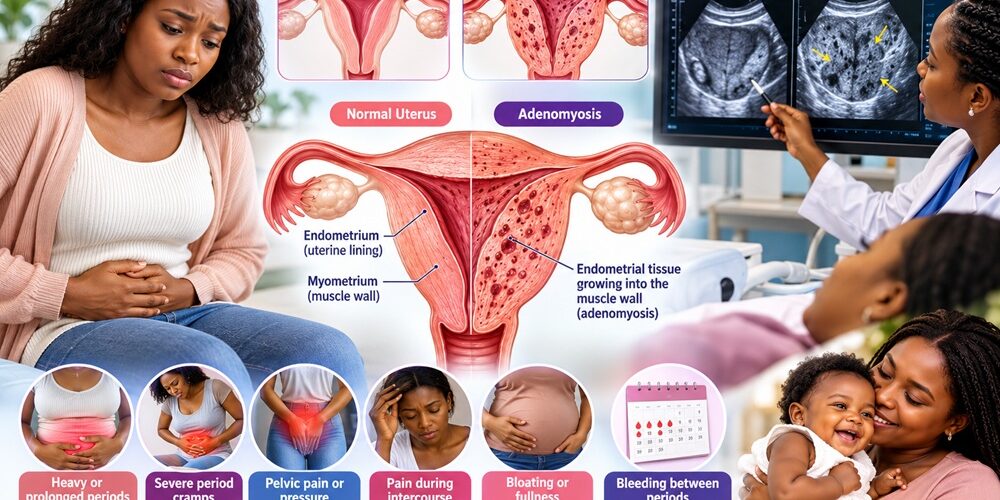
Adenomyosis is a condition in which the tissue that normally lines the uterus (the endometrium) grows into the muscular wall of the uterus (the myometrium).
Each month, this misplaced tissue responds to hormones the same way the uterine lining does. It thickens and bleeds into the muscle wall, causing inflammation, swelling, and pain. Over time, the uterus can become enlarged and stiff.
Adenomyosis is not cancer or an infection. It is often confused with two other conditions:
- Endometriosis: similar tissue grows outside the uterus. The two conditions can occur together.
- Fibroids: these are distinct, rounded muscle growths. Adenomyosis is usually more diffuse and blends into the uterine wall.
Once thought to affect only women in their 40s and 50s, adenomyosis is now recognized more often in women in their 20s and 30s, largely because imaging has improved.
Symptoms: Why Adenomyosis Is Called a Silent Disease
Some women notice clear warning signs:
- Heavy or prolonged periods
- Severe period cramps that worsen over time
- Pelvic pain or pressure between periods
- Pain during intercourse
- Bloating or a feeling of fullness in the lower abdomen
- Bleeding between periods
Others have no symptoms at all. For them, the only clue may be difficulty getting pregnant or staying pregnant.
Why it is so often missed
- Painful, heavy periods get dismissed as “normal.” Many women live with symptoms for years before asking for help.
- Symptoms overlap with endometriosis, fibroids, and hormonal conditions, so the true cause stays hidden.
- Basic scans can look normal. Spotting the subtle signs takes a trained eye and the right technique.
- Diagnosis used to come only after surgery, such as hysterectomy, which is not an option for women who want children.
How Adenomyosis Affects Fertility
Research shows that adenomyosis can make it harder to conceive and to carry a pregnancy. It does not make pregnancy impossible. Several factors are thought to play a part:
- Irregular uterine contractions. Gentle, coordinated contractions help sperm travel and help an embryo settle. Adenomyosis can disturb this rhythm.
- Chronic inflammation. An inflamed uterine environment may be less welcoming to an embryo.
- Reduced endometrial receptivity. The lining may not be fully ready during the narrow “window” when implantation can happen.
- A disrupted junctional zone. This is the inner muscle layer just beneath the lining. It matters for implantation and for the early development of the placenta.
- Hormonal imbalance. Higher local estrogen and a weaker progesterone response can affect the lining.
The result can be lower implantation rates, a higher risk of early miscarriage, and, in some studies, a greater chance of pregnancy complications such as preterm birth. This is why finding adenomyosis before treatment or pregnancy gives you a real advantage.
How Our Ultrasound Expertise Detects Adenomyosis
At Medical Art Center Clinic, skilled hands use ultrasound to identify adenomyosis, so you don’t have to wait for surgery. Image quality matters, but interpretation matters more: the signs are subtle and easy to overlook without specific training.
What our specialists look for
- A rounded (“globular”) or unevenly thickened uterus
- Tiny cysts within the muscle wall
- Bright streaks or islands inside the myometrium
- Fan-shaped shadowing that hides the normal texture of the muscle
- A blurred, irregular, or interrupted junctional zone
- Abnormal blood vessel patterns within the uterine wall
Our approach
- Detailed transvaginal ultrasound. A close, high-resolution view of the uterus and ovaries.
- 3D ultrasound. This reveals the junctional zone, which a standard 2D scan often cannot show clearly.
- Structured assessment. We record findings using internationally recognized ultrasound criteria, so results are consistent and can be compared over time.
- Mapping the disease. We note whether it is diffuse or focal, which wall is affected, and how deep it reaches. This shapes your treatment plan.
- A whole-picture review. We also check for endometriosis, fibroids, polyps, and other fertility-related findings.
Why ultrasound works for you
It is painless, involves no radiation or sedation, and can be repeated to see how you respond to treatment. In most cases, it removes the need for an MRI, which we reserve for unclear or complex findings.
Treatment and Management Options
No single treatment works for every woman. Your plan depends on your age, ovarian reserve, symptoms, disease extent, and how long you have been trying to conceive.
| Approach | What it does | When it may be used |
|---|---|---|
| Medical suppression (such as GnRH agonist pretreatment) | Calms inflammation and can reduce uterine size before conception | Before IVF or frozen embryo transfer, usually for a few months |
| Frozen embryo transfer in a prepared cycle | Lets the embryo transfer happen when the uterus is in its best state | Commonly used with IVF in women with adenomyosis |
| Treating related conditions | Removes polyps and addresses endometriosis or fibroids | When the scan shows them |
| Surgery (adenomyomectomy) | Removes focal disease while preserving the uterus | Carefully selected cases, weighing the risks to a future pregnancy |
| Monitored natural cycles or IUI | Tracks ovulation and lining closely with ultrasound | Mild disease, younger women, and shorter time trying |
Many hormonal medicines used for adenomyosis also prevent pregnancy. That is why timing and specialist planning matter: the right treatment at the wrong moment can delay your goal.
From Diagnosis to a Healthy Baby
A diagnosis of adenomyosis is not the end of your fertility journey. It is the start of a smarter plan. Here is how care at the center is built around that goal:
- Accurate diagnosis. Specialized ultrasound finds and maps the condition.
- A personalized plan. We decide together whether to treat first or move straight to fertility treatment.
- Precise monitoring. Repeated scans track your response and help time embryo transfer or conception.
- Early pregnancy support. Early scans confirm a healthy pregnancy, and ongoing monitoring of growth and cervical length continues alongside your obstetrician, because pregnancies with adenomyosis benefit from closer follow-up.
Our goal is not only a positive pregnancy test. It is a healthy, live baby in your arms. Every journey is different, and no clinic can promise a result, but identifying and treating adenomyosis removes a hidden obstacle that standard testing can miss.
Frequently Asked Questions
Can I get pregnant if I have adenomyosis?
Yes. Many women conceive naturally or with fertility treatment. It may take longer and often needs expert support, but adenomyosis does not mean you cannot have a baby.
Is adenomyosis the same as endometriosis?
No. In adenomyosis, tissue grows into the uterine muscle wall. In endometriosis, it grows outside the uterus. They can occur together, so you need to assess both.
Does adenomyosis cause miscarriage?
Studies link adenomyosis with a higher risk of miscarriage. This is one of the main reasons to diagnose and manage it before you try to conceive or transfer an embryo.
Can adenomyosis be cured?
Hysterectomy is the only definitive cure, and it ends fertility. For women who want children, treatment aims to control the disease and support pregnancy. Symptoms usually ease after menopause.
Do I need an MRI to diagnose adenomyosis?
Often not. In experienced hands, transvaginal and 3D ultrasound can detect and map adenomyosis. MRI is kept for unclear or complex cases.
Don’t Ignore the Signs: Book an Assessment
Consider seeing a fertility specialist if you have:
- Heavy or painful periods that disrupt your life
- Pelvic pain or pain during intercourse
- Trouble conceiving after 12 months of trying (6 months if you are over 35)
- Recurrent miscarriage
- Repeated failed IVF or embryo transfers with no clear explanation
At Medical Art Center Clinic, our specialized ultrasound assessment can give you answers and a clear plan. Book your consultation today at www.medicalartcenter.com and take the first step toward the family you are hoping for.
This article is for general information only and is not a substitute for medical advice. Please consult a qualified doctor about your own situation.