
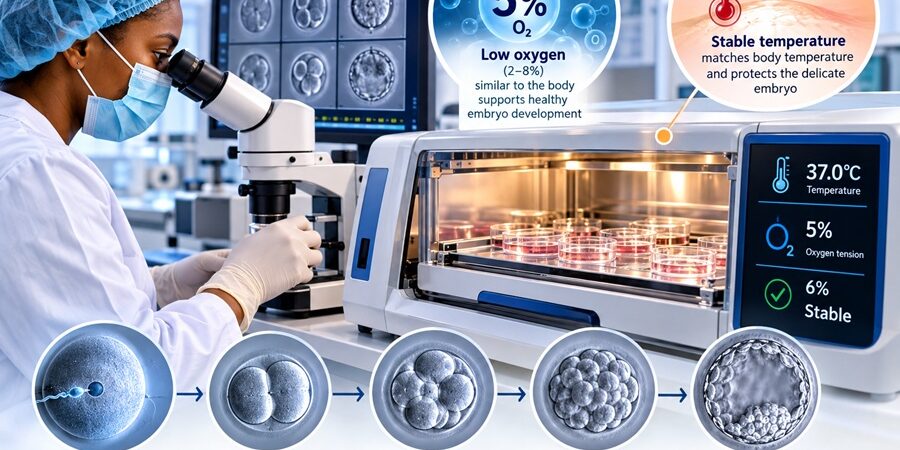
The Science of Embryo Culture: Oxygen Tension and Temperature Sensitivity
SEO details (for your web team)
- Title tag: Embryo Culture Science: Oxygen Tension & Temperature in IVF
- Meta description: Learn how IVF labs control oxygen tension and temperature to protect developing embryos, and what it means for your fertility treatment.
- URL slug: /embryo-culture-oxygen-tension-temperature
- Primary keyword: embryo culture
- Secondary keywords: oxygen tension IVF, embryo incubator temperature, IVF lab conditions, low oxygen embryo culture, time-lapse incubator, embryo development
An embryo’s first five or six days are the most delicate of its life. In an IVF cycle, they happen not in the body but in a small, carefully engineered incubator.
That incubator has one job: to recreate the conditions of the fallopian tube and uterus as closely as science allows. Two of the most important dials are oxygen tension and temperature.
In this guide, we take you inside the IVF laboratory at Medical Art Center Clinic. You will learn why these two settings matter, how labs control them, and what it means for your treatment.
Why embryo culture conditions matter
Embryo culture is the period between fertilization and either embryo transfer or freezing. During these days, a single fertilized cell divides repeatedly until it becomes a blastocyst, a ball of well over 100 cells.
Every step depends on the surroundings. Embryos have no blood supply and no protective tissue. They rely entirely on the culture medium and the surrounding air.
Inside the body, the fallopian tube and uterus provide a stable, low-stress environment. The IVF lab has to match it, because even small stresses can affect how an embryo grows. Researchers still study how much each factor matters. What is clear is that a stable, gentle environment gives embryos the best chance to show their potential.
Oxygen tension: why less is more
The air we breathe is about 20% oxygen. The female reproductive tract is far lower, with estimates generally ranging from about 2% to 8%. Embryos evolved to develop in that low-oxygen setting.
What high oxygen does to embryos
Too much oxygen creates reactive oxygen species. These unstable molecules can cause oxidative stress, which may damage cell membranes, proteins, and DNA. Embryos have limited ability to defend themselves, so extra oxidative stress is a real concern.
What the evidence shows
Many IVF labs now culture embryos at about 5% oxygen instead of atmospheric levels. Reviews of randomized trials have linked low-oxygen culture with better embryo development and higher pregnancy and live birth rates. Results vary between studies, and the benefit appears strongest when embryos are grown to the blastocyst stage.
For this reason, low-oxygen culture is widely regarded as a best practice in modern IVF.
How labs maintain it
Labs supply a precise gas mix to the incubator. A typical setup uses about 5% oxygen and 6% carbon dioxide, with nitrogen making up the rest. Sensors monitor the mix continuously, and alarms alert staff if it drifts.
Temperature sensitivity: the 37°C standard
Human body temperature is about 37°C, and embryo incubators are set to match it. Small deviations matter more than you might expect.
Eggs are especially sensitive
An egg’s meiotic spindle is a delicate structure that sorts the chromosomes. Cooling can cause the spindle to disassemble. It often recovers when warmed, but repeated or prolonged temperature drops are best avoided because errors in chromosome sorting can affect embryo health.
Embryos are sensitive too
Developing embryos divide on a tight schedule. Temperature swings can disturb cell division and metabolism. That is why labs work hard to keep embryos warm every time they leave the incubator.
How labs protect temperature
- Heated microscope stages and warmed work surfaces during procedures
- Pre-warmed dishes and culture medium
- Short, planned handling times outside the incubator
- Regular calibration of thermometers and heating elements
- Alarms and backup systems that flag any deviation straight away
Inside a modern IVF lab: controlling the whole environment
Oxygen and temperature work alongside several other controls. Together, they form a tightly managed ecosystem.
- Benchtop incubators: Small chambers hold a few dishes each, so doors open less often. Gas and temperature recover faster after each opening.
- Time-lapse incubators: Built-in cameras photograph embryos at regular intervals. Embryologists can follow development without removing the dish, which keeps conditions steady.
- pH control: Carbon dioxide keeps the culture medium at a stable pH. A mineral oil layer over the medium helps limit evaporation and shifts in temperature and acidity.
- Air quality: Labs filter the air to remove particles and volatile organic compounds, because embryos are sensitive to airborne chemicals.
- Quality control: Staff routinely test, calibrate, and document every incubator, gas supply, and sensor, and they keep backup equipment ready.
These systems are invisible to patients, but they are the foundation of every successful culture.
What this means for you as a patient
A well-run lab cannot change an embryo’s genetics or age, but it can give every embryo the best possible environment. Careful culture protects the potential that is already there.
It is also worth being realistic. Success in IVF depends on many factors, including age, egg and sperm quality, and underlying health. Even excellent lab conditions cannot guarantee a pregnancy.
Questions to ask your fertility clinic
- What oxygen level do you use for embryo culture?
- Do you use benchtop or time-lapse incubators?
- How do you monitor and alarm for temperature and gas changes?
- How does the lab manage air quality?
- How often are incubators and equipment calibrated and checked?
A good clinic will be glad to explain its lab practices in plain language.
Frequently asked questions
What is oxygen tension in IVF?
Oxygen tension is the oxygen concentration in the embryo’s surroundings. Many IVF labs use about 5%, closer to the reproductive tract, instead of the roughly 20% found in room air.
What temperature are embryos cultured at?
Embryos are cultured at about 37°C, matching normal body temperature. Labs keep this stable with calibrated incubators and heated work surfaces.
Does low-oxygen culture improve IVF success?
Studies have linked low-oxygen culture with better embryo development and higher pregnancy and live birth rates, especially for blastocyst culture. Your own results will depend on many individual factors.
Is it safe for embryos to leave the incubator?
Brief, controlled removal is normal in IVF, such as for checks or transfer. Labs minimize time outside and use warmed equipment to protect the embryos.
How long do embryos stay in the incubator?
Embryos are usually cultured for three to six days, depending on the treatment plan and embryo development.
Talk to our team
Understanding the science can make your fertility journey feel less mysterious. If you have questions about embryo culture or your treatment options, our specialists are here to help.
Book a consultation with Medical Art Center Clinic to learn how our team supports you at every step.