
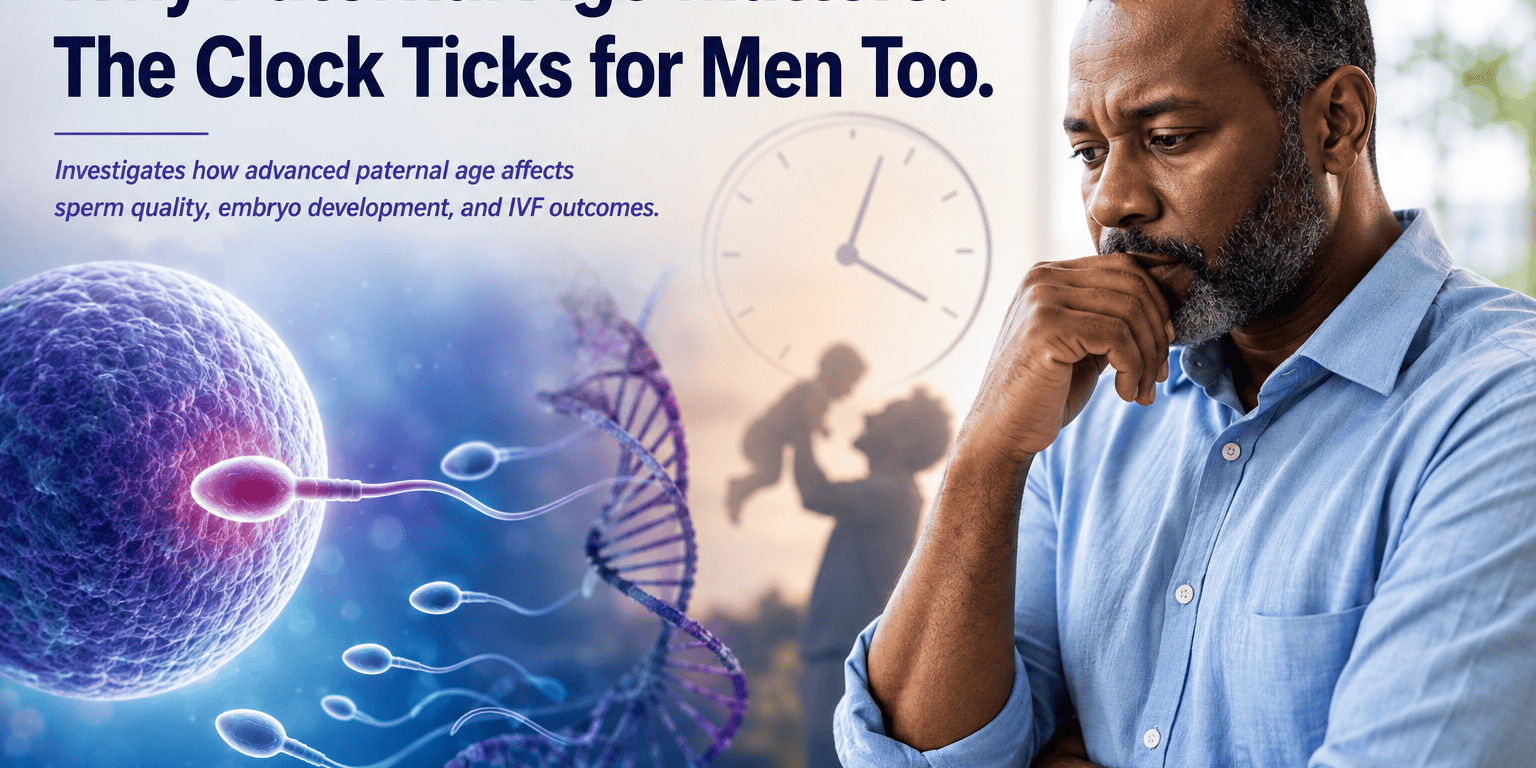
Why Paternal Age Matters: The Clock Ticks for Men Too
Target URL: Medical Art Center
Primary Keyword: advanced paternal age
Secondary Keywords: paternal age and fertility, male fertility after 40, sperm quality and age, older men and IVF, paternal age IVF outcomes, sperm DNA fragmentation, male infertility, IVF for older men
Suggested SEO Title: Why Paternal Age Matters: How a Man’s Age Affects Sperm and IVF Success
Suggested Meta Description: Discover how advanced paternal age affects sperm quality, DNA integrity, embryo development, miscarriage risk and IVF outcomes—and what older men can do to protect fertility.
Suggested Slug: /advanced-paternal-age-sperm-ivf-outcomes/
Why Paternal Age Matters: The Clock Ticks for Men Too
When people talk about the biological clock and fertility, the conversation usually focuses on women.
That makes sense. Female fertility declines significantly with age because the number and quality of available eggs decrease.
But there is another side to the fertility equation that deserves equal attention:
The male biological clock.
Men continue producing sperm throughout adult life, but that does not mean sperm quality remains unchanged. As a man ages—particularly from the fourth and fifth decades onward—changes can occur in sperm concentration, motility, morphology, DNA integrity and genetic quality.
This is known as advanced paternal age (APA).
There is no single universally accepted age that defines advanced paternal age. However, 40 years is commonly used as a practical reference point in research and clinical counseling, while recognizing that reproductive aging is a gradual process rather than an exact cut-off.
For couples trying naturally or undergoing IVF or ICSI, understanding paternal age can therefore be an important part of fertility planning.
What Happens to Sperm as Men Get Older?
Sperm production continues throughout a man’s life, but sperm cells are not immune to aging.
Unlike women, who are born with their lifetime supply of eggs, men continually produce new sperm. However, the cells involved in sperm production divide repeatedly throughout a man’s reproductive life.
With increasing age, the processes responsible for DNA replication and repair can become less efficient.
Research has associated advancing paternal age with several changes, including:
- Reduced semen volume
- Lower sperm motility
- Changes in sperm morphology
- Increased sperm DNA fragmentation
- Greater oxidative stress
- Changes in sperm chromatin packaging
- Increased accumulation of new genetic mutations
A 2026 review published in Maturitas found that advancing paternal age is associated with progressive changes in sperm quality, including reduced motility and increased DNA fragmentation and chromatin instability.
Importantly, age is only one factor. Smoking, obesity, excessive alcohol consumption, heat exposure, infections, medications, environmental toxins, and certain medical conditions can also affect sperm quality.
Sperm DNA: The Hidden Factor
A routine semen analysis measures important characteristics such as:
- Sperm concentration
- Motility
- Morphology
- Semen volume
But these measurements do not tell the entire story.
A man may have a reasonably normal semen analysis while some sperm carry significant DNA damage.
This is why sperm DNA fragmentation has attracted increasing attention in reproductive medicine.
A systematic review involving more than 40,000 men found that 17 of 19 studies assessing the relationship between paternal age and DNA fragmentation reported an association between increasing age and greater sperm DNA fragmentation.
However, sperm DNA fragmentation testing is not recommended as a routine test for every man. Its clinical usefulness depends on the individual circumstances, and current evidence does not support using it indiscriminately for all fertility patients.
It may be considered selectively—for example, in certain cases of recurrent pregnancy loss or repeated ART failure—after discussion with a fertility specialist.
Can Older Sperm Affect the Embryo?
Yes—but the relationship is complex.
After fertilisation, the embryo contains genetic material from both parents.
The egg provides half of the nuclear DNA, while the sperm provides the other half. Sperm also contribute important molecular components involved in early embryonic development.
As paternal age increases, sperm may accumulate:
- DNA strand breaks
- De novo mutations
- Epigenetic changes
- Chromatin abnormalities
- Other molecular changes
These changes may influence embryo development and pregnancy outcomes.
However, it is important not to overstate the evidence.
Advanced paternal age does not mean that a man’s sperm will produce an abnormal embryo or that IVF will fail.
Rather, paternal age is best understood as one risk modifier among many.
Maternal age, egg quality, embryo genetics, uterine factors, sperm characteristics, and overall health all contribute to reproductive outcomes.
Does Paternal Age Increase Embryo Aneuploidy?
This is an area where careful interpretation is particularly important.
Aneuploidy means that an embryo has an abnormal number of chromosomes.
Because sperm chromosomes can be affected by aging, it might seem logical that older paternal age would automatically produce more chromosomally abnormal embryos.
But current evidence does not establish a simple relationship between paternal age and embryo aneuploidy.
For example, ASRM’s 2024 committee opinion notes that studies involving donor-oocyte ICSI cycles did not demonstrate an association between paternal age and embryo aneuploidy.
This distinction matters because maternal age remains a major determinant of embryo aneuploidy.
Therefore, an older father does not automatically mean that an embryo will be chromosomally abnormal.
Advanced Paternal Age and IVF Success
One important question for couples is:
“Can a man’s age affect IVF success?”
The answer is potentially yes.
A systematic review and meta-analysis of more than 32,000 assisted reproduction cycles found evidence of an association between increasing paternal age and reproductive outcomes, although the magnitude and consistency of the effect varied across studies.
ASRM’s more recent guidance also notes that increasing paternal age is associated with reductions in semen quality and may be associated with lower conception rates following IUI and IVF. Some studies have reported lower pregnancy and live-birth rates with increasing paternal age.
This does not mean IVF cannot work for older men.
Many men in their 40s, 50s and beyond father healthy children.
The important point is that paternal age should be incorporated into the overall fertility assessment rather than ignored.
What About Miscarriage?
Several studies have investigated the relationship between paternal age and miscarriage.
The evidence suggests that increasing paternal age may be associated with a modest increase in miscarriage risk.
One proposed mechanism is sperm DNA damage. Another is the accumulation of genetic changes in sperm.
However, miscarriage is multifactorial.
Embryo chromosomal abnormalities, particularly those related to maternal age, remain an important cause of miscarriage. Other factors include uterine abnormalities, hormonal disorders, immune and medical conditions, infections, and lifestyle factors.
Therefore, an older father should not assume that paternal age is the sole explanation for a pregnancy loss.
A comprehensive evaluation of fertility and recurrent pregnancy loss is much more useful than focusing on a single factor.
The Genetic Question: What Changes With Father’s Age?
One of the most interesting effects of paternal aging involves de novo mutations.
A de novo mutation is a genetic change that occurs in the sperm or egg and is therefore new in the child rather than inherited directly from either parent.
Because sperm-producing cells undergo repeated divisions throughout a man’s life, the number of opportunities for replication errors increases with age.
Advanced paternal age has therefore been associated with an increased risk of certain rare genetic conditions caused by new mutations. Research has also identified statistical associations between older paternal age and several neurodevelopmental and psychiatric conditions.
But there is an important perspective:
The absolute risk of any individual condition generally remains low.
Association does not mean that an older father will have an affected child.
This is why fertility and genetic counseling should focus on individual risk rather than fear.
Is There a “Safe” Age for Fatherhood?
There is no biological age at which fatherhood suddenly becomes unsafe.
Male reproductive aging is gradual.
A 41-year-old man and a 61-year-old man do not have identical reproductive risks simply because both are classified as “older.”
Similarly, two men of the same age may have very different sperm quality.
One may have excellent semen parameters, while another may have significant sperm DNA damage or other fertility problems.
This is why individual assessment is more valuable than relying on age alone.
What Should Men Over 40 Do Before IVF?
If you are a man over 40 and considering IVF, IUI or natural conception, there are several sensible steps to consider.
1. Have a proper male fertility assessment
Do not assume fertility is normal simply because you have fathered children previously.
A fertility assessment may include:
- Medical and reproductive history
- Physical examination when indicated
- Semen analysis
- Hormonal evaluation when appropriate
- Assessment for varicocele or other reproductive conditions
- Additional sperm testing when clinically indicated
Male reproductive evaluation should form part of the couple’s fertility assessment.
2. Look beyond the semen count
A high sperm count does not necessarily mean that every sperm is genetically healthy.
Depending on the clinical situation, a fertility specialist may consider additional testing, particularly where there is:
- Recurrent miscarriage
- Repeated IVF failure
- Unexplained infertility
- Significant male-factor infertility
- Advanced paternal age combined with other risk factors
3. Address modifiable lifestyle factors
Although aging itself cannot be reversed, several factors affecting sperm health can potentially be improved.
Men should consider:
- Avoiding tobacco and recreational drugs
- Limiting excessive alcohol
- Maintaining a healthy body weight
- Exercising regularly
- Eating a balanced, nutrient-rich diet
- Managing diabetes, hypertension and other chronic conditions
- Getting adequate sleep
- Avoiding unnecessary heat exposure to the testes
- Reviewing medications with a doctor
- Reducing exposure to relevant environmental toxins
These steps cannot guarantee better fertility, but they support overall reproductive and general health.
Can Sperm Quality Be Improved?
In some men, yes.
Sperm production takes approximately two to three months, meaning that lifestyle and medical interventions generally require time before their full effect can be assessed.
The goal is not to “reverse aging.”
Instead, the objective is to optimize the factors that can be modified and identify medical problems that may be treatable.
For couples undergoing IVF, this can be particularly valuable because even relatively small improvements in sperm quality may be clinically relevant in selected patients.
Should Older Men Consider IVF Earlier?
Not necessarily.
IVF is not automatically required simply because a man is over 40.
However, delaying fertility evaluation for many years may not be advisable, particularly when the female partner is also approaching an age at which egg quantity and quality decline.
The fertility of both partners should be considered together.
For some couples, earlier assessment provides reassurance.
For others, it identifies a problem that can be treated before precious reproductive time is lost.
What Role Does ICSI Play?
Intracytoplasmic sperm injection (ICSI) involves injecting a single sperm directly into an egg.
ICSI can be particularly useful when there is significant male-factor infertility, such as very low sperm numbers or poor motility.
However, ICSI is not a universal solution for the effects of paternal aging.
It can help address certain fertilization issues, but it does not eliminate DNA damage or genetic changes already present in sperm.
Therefore, choosing ICSI should be based on the couple’s clinical circumstances rather than paternal age alone.
What About PGT?
Preimplantation genetic testing (PGT) can be used in selected IVF situations to evaluate embryos for specific genetic or chromosomal conditions.
However, PGT should not be viewed as a test that eliminates every risk associated with advanced paternal age.
For example, PGT-A evaluates the chromosome number of embryos; it does not screen for every possible genetic mutation associated with paternal aging.
Genetic counseling can be particularly useful when there is a strong family history, a known genetic condition or a specific concern about paternal-age-related genetic risk.
The Bottom Line: Men Have a Biological Clock Too
The message is not that men should fear aging.
It is that male reproductive aging deserves the same thoughtful attention given to female reproductive aging.
As paternal age increases, research shows associations with:
↓ Sperm motility
↑ Sperm DNA fragmentation
↑ De novo genetic mutations
↑ Certain reproductive risks
Potential changes in embryo and pregnancy outcomes
At the same time, many older men remain fertile and father healthy children.
Age is therefore a risk factor—not a diagnosis.
The best approach is proactive rather than alarmist: assess fertility, identify modifiable factors, treat medical problems, and obtain personalized reproductive counseling.
When Should a Man See a Fertility Specialist?
Consider a fertility evaluation if you are:
- Over 40 and planning to father a child
- Experiencing difficulty conceiving
- Have had previous fertility problems
- Have experienced recurrent pregnancy loss with your partner
- Have had previous IVF failure
- Have a history of testicular surgery, trauma or infection
- Have a known varicocele
- Have undergone chemotherapy or radiotherapy
- Have concerns about sperm quality
- Have a family history of genetic disease
Early assessment does not mean you will need IVF.
It means you have more information with which to make an informed decision.
Takeaway for Couples Planning Pregnancy
The fertility journey belongs to both partners.
For women, age can influence egg quantity and chromosome quality. For men, increasing age can influence sperm production, DNA integrity, and the genetic material delivered to the embryo.
The good news is that modern reproductive medicine can assess many of these factors.
At Medical Art Center, a comprehensive fertility assessment can help couples understand their individual reproductive profile and determine the most appropriate path toward pregnancy.
Don’t wait until fertility becomes a problem before asking the important questions.
Planning a Pregnancy After 40?
If you or your partner are concerned about paternal age, sperm quality, male fertility, or IVF success, speak with a fertility specialist for an individual assessment.
Medical Art Center — helping couples make informed decisions on the journey to parenthood.
Visit Medical Art Center
Frequently Asked Questions
Does male fertility decline after 40?
Male fertility generally declines gradually rather than suddenly. Increasing age is associated with changes in semen parameters and greater sperm DNA fragmentation, although individual men vary considerably.
Is 40 considered advanced paternal age?
There is no universally agreed definition, but age 40 is commonly used as a practical reference point for advanced paternal age in research and clinical counseling.
Can an older man still have healthy children?
Yes. Most older fathers do not have children with age-related genetic conditions. However, some reproductive and genetic risks increase gradually with paternal age.
Does an older father increase the risk of miscarriage?
Research suggests that advanced paternal age may be associated with a modest increase in miscarriage risk, although miscarriage has many possible causes and maternal age remains an important factor.
Does paternal age cause embryo aneuploidy?
Current evidence does not establish a clear association between paternal age and embryo aneuploidy. Maternal age is a well-established determinant of embryonic chromosomal abnormalities.
Can IVF overcome the effects of advanced paternal age?
IVF and ICSI can help overcome some forms of male-factor infertility, but they cannot completely eliminate age-related sperm DNA or genetic changes. Treatment should therefore be individualized.
Should men over 40 have sperm DNA fragmentation testing?
Not routinely. The usefulness of sperm DNA fragmentation testing depends on the clinical situation. It may be considered selectively in situations such as recurrent pregnancy loss or repeated ART failure.
Medical Disclaimer
This article is intended for general educational purposes and does not replace individual medical advice, diagnosis or treatment. Fertility and genetic risks vary between individuals. Couples concerned about paternal age or reproductive health should consult a qualified fertility specialist for personalized assessment and counseling.