Varicocele and Male Infertility: Treatment, Sperm Retrieval and ICSI
19 November 2026 · Professor Oladapo Ashiru, OFR
Quick answer: A varicocele is a swelling of the veins in the scrotum. It is one of the most common treatable causes of male infertility. Some men benefit from a minor operation to repair it. Men with very low sperm counts, or none at all, can often still become fathers through surgical sperm retrieval and ICSI. The right path depends on a careful check of both partners.
When a couple struggles to conceive, attention often turns to the woman first. Yet a male factor plays a part in up to half of all infertility cases.
One of the most common male causes is a varicocele. The good news? It can often be treated.
At Medical Art Center in Lagos, we believe that understanding your condition is the first step to the right treatment. This guide explains:
- what a varicocele is and how it affects fertility
- when repair helps, and when it doesn’t
- how sperm retrieval and ICSI give men with severe male infertility a real chance of fatherhood
What is a varicocele?
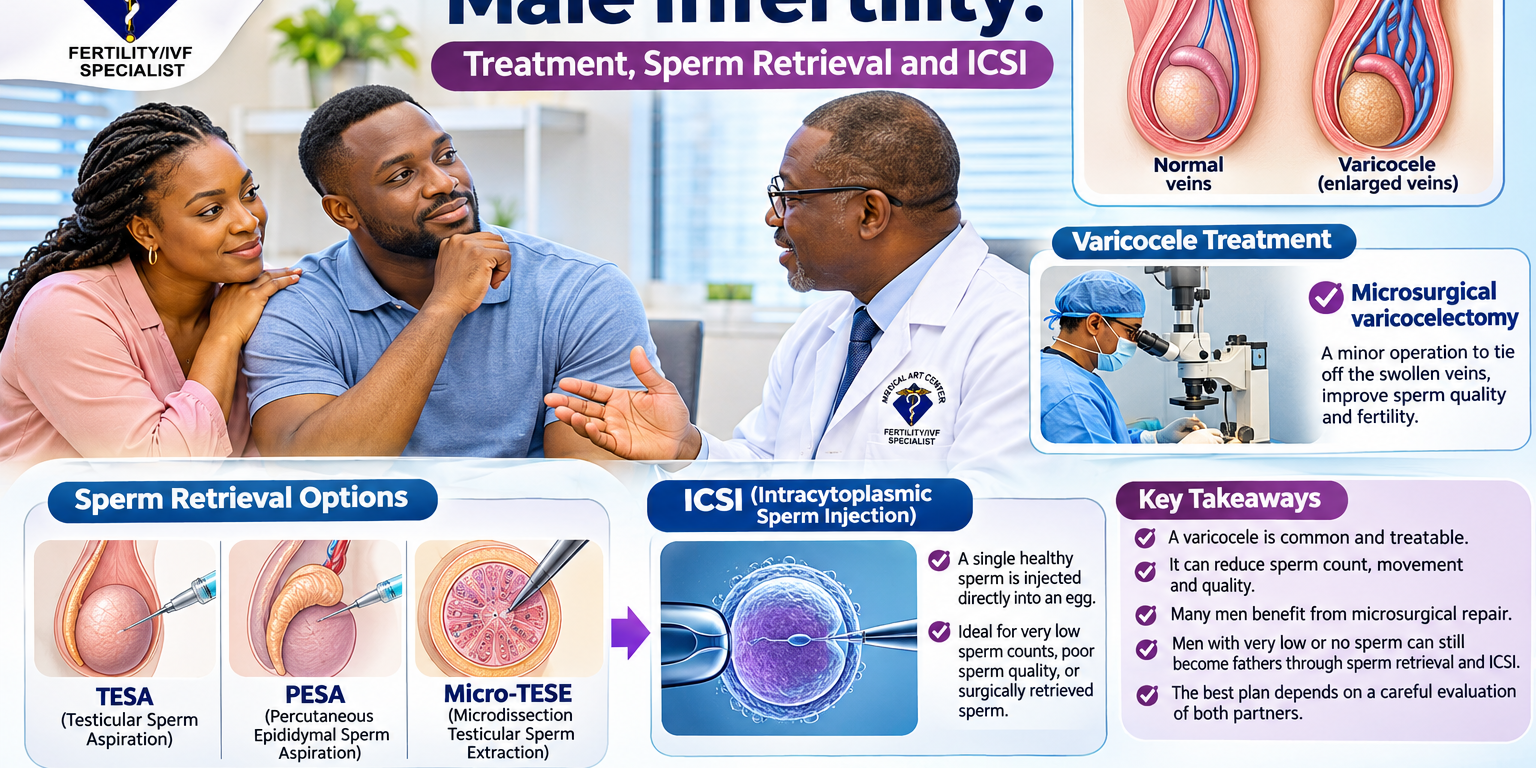
A varicocele is a cluster of enlarged veins inside the scrotum. Think of it as varicose veins, but around the testicle.
- It is common. About 15 in every 100 men have one.
- It is even more common in men with fertility problems. Roughly 35 to 40 in every 100 men being checked for infertility have a varicocele.
- It usually affects the left side.
- It is often silent. Most men have no symptoms and only find out during a fertility check-up. A few notice a dull ache or a heavy feeling in the scrotum.
How does a varicocele affect fertility?
Your testicles work best when they are slightly cooler than the rest of your body.
A varicocele lets blood pool around the testicle. This raises its temperature and increases oxidative stress, a type of cell damage.
Over time, this can cause:
- Low sperm count: fewer sperm
- Poor motility: sperm that don’t swim well
- Abnormal shape (morphology): fewer normally formed sperm
- Sperm DNA damage: which can affect embryo quality
Important: Not every man with a varicocele is infertile. That is why a proper assessment matters.
How is a varicocele diagnosed?
Diagnosis usually takes three simple steps:
- Physical examination. The doctor gently examines the scrotum while you stand and bear down. Doctors grade varicoceles from 1 to 3 by size.
- Scrotal ultrasound (Doppler). This confirms the diagnosis. It can also find small varicoceles that can’t be felt, called subclinical varicoceles.
- Semen analysis. At least two tests check sperm count, movement and shape. Your doctor may also suggest a sperm DNA fragmentation test.
Does every varicocele need surgery?
No. Many varicoceles never need treatment.
Our andrology specialists look at the whole picture, including:
- the size (grade) of the varicocele
- your semen analysis results
- your partner’s age and fertility
- whether you have scrotal pain
- how long you have been trying to conceive
Microsurgical varicocelectomy: the gold standard
When repair is advised, microsurgical varicocelectomy is the preferred method.
Using an operating microscope, the surgeon closes off the swollen veins while protecting the artery and lymph vessels. This lowers the risk of complications and of the varicocele coming back.
What to expect:
- It is a day-case procedure, so you go home the same day.
- Most men return to light work within a few days.
- Sperm take about three months to develop, so semen quality usually improves three to six months after surgery.
What does the evidence show?
In one randomized study, men with a subclinical varicocele and poor semen results either had microsurgical repair or no surgery. Men who had the repair:
- had higher sperm counts afterward
- achieved a natural pregnancy rate of 29.1%, compared with 4% in men who did not have surgery
For men with a larger varicocele and abnormal semen results, repair may also improve sperm quality. For some couples, this opens a chance of natural conception. For others, it may mean a simpler fertility treatment than they would have needed before.
Sperm retrieval for azoospermia
Some men have azoospermia: no sperm in the semen at all.
This does not always mean there is no sperm. Often, doctors can collect sperm directly from the testicle or the epididymis (the coiled tube behind the testicle). The right procedure depends on the type of azoospermia.
Obstructive azoospermia: a blockage
Here, the testicles make sperm, but a blockage stops it from getting out. Sperm can usually be collected with one of these procedures:
- TESA (Testicular Sperm Aspiration): a fine needle draws sperm from the testicle under local anesthetic.
- PESA (Percutaneous Epididymal Sperm Aspiration): a fine needle draws sperm from the epididymis.
- MESA (Microsurgical Epididymal Sperm Aspiration): a small operation under the microscope that collects larger numbers of sperm from the epididymis.
These are usually day-case procedures with a quick recovery.
Non-obstructive azoospermia: low sperm production
Here, the testicles make very little sperm. The challenge is finding small pockets of tissue where sperm is still being made.
Micro-TESE (Microdissection Testicular Sperm Extraction) is the preferred procedure. Using a high-powered microscope, the surgeon removes only the tubules most likely to contain sperm. This:
- improves the chance of finding sperm
- removes as little tissue as possible
- helps protect testicular function
At Medical Art Center, TESA is part of our specialized andrology services, supported by our full embryology laboratory.
ICSI: turning a few sperm into a chance of pregnancy
Once sperm is collected, whether from semen or by surgery, it is often used for ICSI (Intracytoplasmic Sperm Injection).
ICSI is a specialized form of IVF. An embryologist picks a single healthy-looking sperm and injects it directly into a mature egg. The sperm no longer has to swim to the egg or break through its outer layer on its own.
ICSI is ideal when:
- the sperm count is very low
- sperm movement or shape is poor
- sperm has been collected surgically
- fertilization failed in a previous IVF cycle
Should a varicocele be repaired before ICSI?
This is one of the questions we hear most. The honest answer: it depends.
Earlier studies suggested that repairing a varicocele before ICSI might improve results. However, newer and better-designed research found that, for couples going straight to ICSI, repairing a clinical varicocele first did not significantly improve live birth rates.
In practice:
- Going straight to ICSI? You may not need varicocele repair for that cycle to succeed.
- Hoping to conceive naturally? Repair may still be worth considering. It can also improve sperm quality for the long term or relieve scrotal pain.
- Very low sperm count? This is a special case. In some men, repair brings sperm back into the semen, which may avoid the need for surgical retrieval.
That is why every couple at Medical Art Center receives individual counseling, not a one-size-fits-all answer.
When should you see a fertility specialist?
Book a fertility evaluation if:
- you have been trying to conceive for 12 months without success
- you have been trying for 6 months, and the female partner is over 35
- you have a known varicocele, scrotal swelling, or pain
- You have had past surgery, injury, or infection affecting the testicles
- A previous semen analysis was abnormal
Frequently asked questions
Can a varicocele cause infertility?
Yes. A varicocele can raise testicular temperature and reduce sperm count, movement, and quality. However, many men with a varicocele are still fertile, so a full evaluation is needed.
Can a varicocele go away on its own?
No, it usually does not. But many varicoceles need no treatment at all if they don’t affect fertility or comfort.
How long after varicocele surgery will my sperm improve?
Most men see changes in their semen analysis three to six months after surgery. That is how long new sperm take to develop.
Can a man with a zero sperm count father a child?
Often, yes. Many men with azoospermia have sperm that can be found through TESA, MESA, or Micro-TESE. This sperm can then be used for ICSI.
Is ICSI successful with surgically retrieved sperm?
Yes. ICSI was developed for exactly this situation. Success depends mostly on the female partner’s age and egg quality, along with sperm and embryo quality.
Your next step at Medical Art Center
Male infertility is common, treatable, and often misunderstood.
At Medical Art Center, our andrology specialists work closely with our reproductive endocrinologists and embryologists. Together, they build one clear plan for both partners, based on your exact diagnosis.
Whether you are considering varicocele repair, preparing for sperm retrieval, or planning ICSI, it all starts with a thorough evaluation.
Ready to take the first step? [Book a consultation with our fertility team today.]
Understanding the male factor isn’t just empowering. It is an essential part of building your family.