Preconception Checkup in Lagos: 12 Tests to Do Before You Try for a Baby
Nov 11, 2026 · @Professor Oladapo Ashiru, OFR
Why a preconception checkup matters
The healthiest pregnancies often begin months before conception. A preconception checkup finds hidden problems early, while there is still time to treat them, so you and your partner start trying from your strongest position.
In Lagos, this matters even more. Sickle cell trait is common in Nigeria, fibroids affect many Black women, and daily exposure to traffic fumes, generator smoke, oil pollution, and household chemicals can quietly affect egg and sperm health. Many of these issues cause no symptoms until a couple struggles to conceive or a pregnancy runs into trouble.
The good news: most can be detected with simple blood tests, a scan, and a semen analysis. Below are the 12 tests we recommend at Mart-Life Detox Clinic, located within the Medical Art Center in Lagos, and what each one tells you.
When to book, and why both partners should come
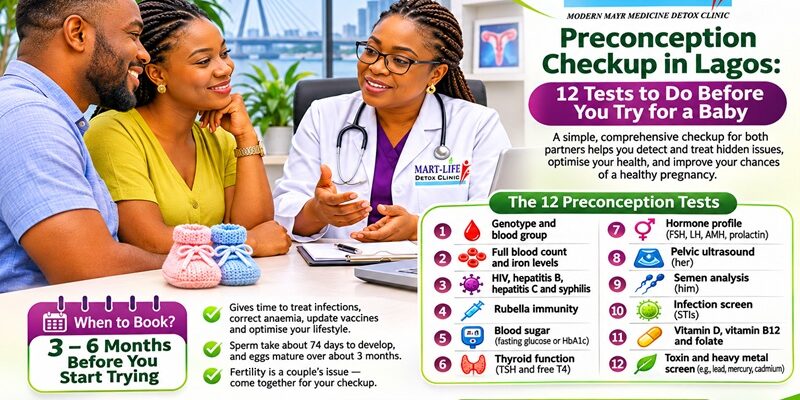
Book your checkup 3 to 6 months before you start trying. That window gives time to treat infections, correct anemia, adjust medications, update vaccines, and improve lifestyle habits.
The timing is biological, not arbitrary. Sperm take roughly 74 days to develop, and eggs go through their final stage of maturation over about three months. The choices you make today shape the eggs and sperm that will make your baby.
Fertility is a couple’s issue. Male factors contribute to about half of the cases where couples struggle to conceive, yet many men in Nigeria are never tested. Come together: several tests below are for both of you, and one is for him alone.
The 12 preconception tests to do before you try for a baby
1. Genotype and blood group (both partners)
Your genotype (AA, AS, AC, SS, SC) shows whether you carry sickle cell genes. If both partners carry a trait, for example AS and AS, each pregnancy has a 1 in 4 chance of a child with sickle cell disease. Knowing early lets you explore options such as IVF with preimplantation genetic testing (PGT).
Your blood group and Rhesus factor matter too. A Rhesus-negative woman with a Rhesus-positive partner needs anti-D protection in pregnancy to keep her baby safe.
2. Full blood count and iron levels (her, and ideally him)
Anemia is common among Nigerian women of reproductive age and worsens in pregnancy, when blood volume rises. A full blood count, with ferritin to check iron stores, lets you correct low levels before conception rather than during it.
3. HIV, hepatitis B, hepatitis C and syphilis (both partners)
These infections can pass to a baby during pregnancy or birth, and many people carry them without symptoms. Early diagnosis means treatment, vaccination against hepatitis B where needed, and a far lower risk of passing infection to your child.
4. Rubella immunity (her)
Rubella (German measles) in early pregnancy can cause deafness, heart defects and miscarriage. A simple blood test shows whether you are immune. If not, you can be vaccinated and should wait at least one month before trying to conceive.
5. Blood sugar: fasting glucose or HbA1c (both partners)
Undiagnosed diabetes raises the risk of miscarriage, birth defects, and a very large baby. In men, high blood sugar can affect sperm quality and erectile function. HbA1c shows your average blood sugar over the past three months.
6. Thyroid function: TSH and free T4 (her)
An underactive or overactive thyroid can disrupt ovulation and raise the risk of miscarriage. Treatment is simple, and your thyroid levels should be well controlled before you conceive.
7. Blood pressure, kidney and liver function (both partners)
High blood pressure is often silent and is a major cause of complications such as pre-eclampsia. Kidney and liver tests show how well your body clears waste and toxins, and whether any medicines you take need adjusting before pregnancy.
8. Pelvic ultrasound scan (her)
A transvaginal scan checks the womb and ovaries for fibroids, polyps, ovarian cysts, signs of polycystic ovaries (PCOS) and adenomyosis. Fibroids are especially common among African women, and their size and position determine whether they affect fertility.
9. Cervical screening and STI swabs (her, with partner treatment if positive)
A Pap smear or HPV test screens for early cervical changes. Swabs for chlamydia and gonorrhoea matter because these infections can silently damage the fallopian tubes, a leading cause of infertility in Nigeria. If you test positive, your partner must be treated too.
10. Ovarian reserve and hormone profile (her)
Anti-Müllerian hormone (AMH) estimates how many eggs you have left. A day 2–3 hormone panel (FSH, LH, oestradiol) and prolactin add detail on ovulation. This is especially useful if you are 35 or older, have irregular periods, or plan to delay pregnancy.
11. Semen analysis (him)
This single test checks sperm count, movement (motility), and shape (morphology). It is quick, painless, and one of the most important tests on this list. Many sperm problems improve with treatment and lifestyle changes over about three months.
12. Vitamin D and environmental toxin screen (both partners)
Low vitamin D is surprisingly common, even in sunny Lagos, because many people work indoors. Adequate levels support egg quality, sperm health, and a healthy pregnancy.
A toxin screen can check for heavy metals such as lead and mercury. In Lagos, exposure can come from vehicle and generator fumes, some skin-lightening creams, contaminated water, and certain traditional remedies. These metals can disrupt hormones and harm a developing baby. This test is a Mart-Life Detox Clinic specialty.
Beyond the tests: preparing your body for pregnancy
Test results are only half the picture. Your checkup should end with a plan for the months ahead. Common steps include:
- Start folic acid now. Women should take 400 micrograms daily, starting at least one month before conception, to help prevent neural tube defects. Some women need a higher dose, so ask your doctor.
- Review your medications. Some prescriptions, herbal mixtures, and supplements are unsafe in early pregnancy.
- Cut down on endocrine disruptors. Chemicals in some plastics, pesticides, and cosmetics can mimic or block hormones. Avoid heating food in plastic, choose fragrance-free products where you can, and wash fruit and vegetables well.
- Quit smoking and limit alcohol. Both partners benefit, as smoking and alcohol harm egg and sperm quality.
- Protect sperm from heat. Avoid laptops on the lap, hot baths, and very tight underwear.
- Manage stress and sleep. Chronic stress and poor sleep affect hormones in both men and women.
- Reach a healthy weight. Being significantly over- or underweight can disrupt ovulation and sperm production.
At Mart-Life Detox Clinic, we combine these steps with a personalized detox program that supports your liver, gut, and hormones, so your body is ready for a healthy pregnancy.
Frequently asked questions
How long does a preconception checkup take?
Most blood samples, the scan, and the consultation can be done in one or two visits. Results usually come back within a few days, and a semen analysis is often reported the same day or the next.
Do we need a checkup if we are young and healthy?
Yes. Many conditions on this list, including sickle cell trait, silent infections, fibroids, and low sperm count, cause no symptoms. A healthy-feeling couple can still benefit from knowing.
We have been trying for a while. When should we see a fertility specialist?
See a specialist if you have tried for 12 months without success and the woman is under 35, or after 6 months if she is 35 or older. If she is over 40, or either of you has a known condition, come in straight away.
Can a detox program improve our chances of conceiving?
Reducing your exposure to toxins, eating well, sleeping better, and managing stress all support egg and sperm health. A medically supervised detox plan helps you make those changes safely, alongside any treatment your doctor recommends.
Is a preconception checkup only for women?
No. Men should have genotype, infection, blood sugar, blood pressure, vitamin D, and toxin tests, plus a semen analysis.
Book your preconception checkup in Lagos
A baby is worth planning for. At Mart-Life Detox Clinic, within the Medical Art Center in Lagos, we offer a complete preconception package for couples: all 12 tests, a consultation to explain your results, and a personalized plan to prepare your body for pregnancy.
Our team brings together fertility specialists and detox experts, so you get both medical answers and practical support in one place. If any result needs further care, our fertility team at Medical Art Center can see you without delay.
Start your journey to a healthy pregnancy today. Call [phone number], WhatsApp [WhatsApp number], or book online at [booking link].
This article is for general information and does not replace personal medical advice. Speak to a doctor about the tests that are right for you.