Endometriosis and Infertility: Symptoms, Diagnosis and Your Options
11 Nov 2026 · @Professor Oladapo Ashiru, OFR
SEO details (for the web team)
| Field | Entry |
| SEO title (≤60 characters) | Endometriosis and Infertility: Symptoms & Options |
| Meta description (≤155 characters) | Painful periods and trouble conceiving? Learn how endometriosis affects fertility, how it is diagnosed, and the treatment options at Medical Art Center, Lagos. |
| URL slug | /endometriosis-and-infertility |
| Focus keyword | endometriosis and infertility |
| Secondary keywords | endometriosis symptoms, endometriosis diagnosis, can I get pregnant with endometriosis, endometriosis treatment Lagos, IVF for endometriosis, fertility clinic Lagos |
| Internal links | Adenomyosis: A Silent Disease Affecting Fertility · What to Expect at Your First Fertility Consultation at Medical Art Center · PRP article |
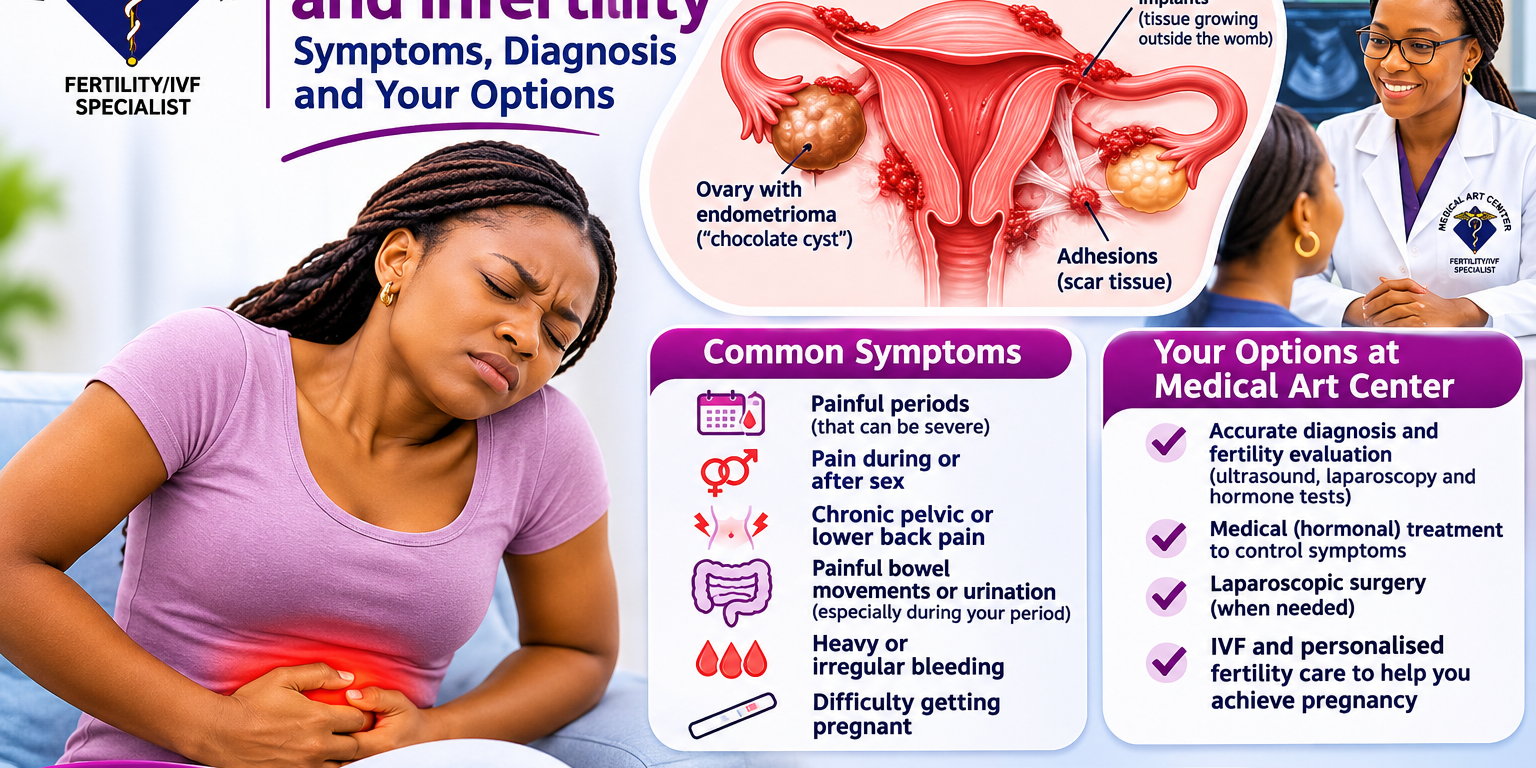
| Suggested image alt text | Woman holding her lower abdomen during painful period, endometriosis symptoms |
Painful periods are not “just part of being a woman”
Many women are told that severe period pain is normal. They are told to endure it, take a painkiller, and wait for it to pass. For some, that pain is a sign of endometriosis, and it may be the same reason pregnancy has not happened.
The good news: endometriosis is treatable, and many women with it go on to have healthy babies. The key is an accurate diagnosis and a plan built around your goals.
What is endometriosis?
Endometriosis is a condition in which tissue similar to the lining of the womb (the endometrium) grows outside the womb. It is commonly found on the ovaries, fallopian tubes, the ligaments behind the womb, the bowel, and the bladder.
Like the womb lining, this tissue responds to your monthly hormones. It becomes inflamed and can bleed, but the blood has nowhere to go. Over time, this causes:
- Inflammation in the pelvis
- Scar tissue and adhesions that can stick organs together
- Endometriomas, or “chocolate cysts”, on the ovaries
Endometriosis affects roughly 1 in 10 women of reproductive age worldwide. Yet many wait years, often 7 to 10, before they get a diagnosis.
Endometriosis has a close cousin, adenomyosis, where similar tissue grows into the muscle wall of the womb. The two often occur together. Read more in our article Adenomyosis: A Silent Disease Affecting Fertility.
Common symptoms of endometriosis
Symptoms vary widely. Some women have severe pain; others have none at all and only discover endometriosis while being investigated for infertility. Pain doesn’t always match how much disease is present.
Watch for these signs:
- Painful periods (dysmenorrhoea) that get worse over time or stop you from going to work or school
- Pain during or after sex, especially deep pain
- Chronic pelvic or lower back pain outside your period
- Painful bowel movements or urination, especially during your period
- Heavy or irregular bleeding, or spotting between periods
- Bloating, nausea, or constipation that flares with your cycle
- Constant tiredness
- Difficulty getting pregnant
When to see a specialist: if period pain regularly needs strong painkillers, if sex is painful, or if you have tried for a baby for 12 months (or 6 months if you are 35 or older) without success. If you already have symptoms like those above, do not wait the full year.
How does endometriosis affect fertility?
Up to half of women with endometriosis have difficulty conceiving, and endometriosis is found in a large share of women investigated for infertility. It does not mean you cannot get pregnant. It means the path may need support.
Endometriosis can reduce fertility in several ways:
- Blocked or damaged tubes. Adhesions can distort the fallopian tubes or stop them from picking up the egg.
- An inflamed pelvic environment. Inflammatory chemicals in the pelvic fluid can harm sperm, eggs, and early embryos.
- Lower egg quality and quantity. Endometriomas can damage healthy ovarian tissue and lower your ovarian reserve (often measured by AMH).
- A less receptive womb lining. Changes in the endometrium may make it harder for an embryo to implant.
- Painful sex. When intercourse hurts, couples naturally have it less often.
Doctors grade endometriosis from Stage I (minimal) to Stage IV (severe). Stage matters, but it is not the whole story. Your age, ovarian reserve, tubal health, and your partner’s semen quality all shape your chances and your best treatment.
How is endometriosis diagnosed?
Diagnosis today often starts without surgery. International guidelines now accept that a skilled specialist can diagnose many cases with careful imaging, saving keyhole surgery for when it can also treat the problem.
A typical assessment includes:
- A detailed history. Your pain pattern, cycle, bowel and bladder symptoms, and how long you have tried to conceive.
- Pelvic examination. Tender areas or nodules behind the womb can point to deep endometriosis.
- Transvaginal ultrasound. In expert hands, this detects endometriomas, deep nodules, adhesions (“sliding sign”), and adenomyosis. The skill of the person scanning matters a great deal.
- MRI, when deep disease of the bowel or bladder is suspected, or surgery is being planned.
- Fertility tests. AMH and antral follicle count for ovarian reserve, a tubal test such as HSG or HyCoSy, and a semen analysis for your partner.
- Laparoscopy (keyhole surgery), when imaging is unclear, or treatment is needed at the same time. Tissue can be sent for confirmation.
A normal scan does not always rule out endometriosis, because early, superficial disease can be too small to see. If your symptoms are typical, your specialist may still treat you.
Your options: treating endometriosis when you want a baby
The right treatment depends on one question first: are you trying to conceive now? Hormonal treatments relieve pain but stop ovulation, so they do not improve fertility on their own. If pregnancy is the goal, the plan focuses on getting you pregnant safely and efficiently.
| Option | Best suited for | What to know |
| Pain relief and hormonal treatment (pill, progestins, GnRH medicines) | Women not trying to conceive yet | Controls pain and slows disease; you cannot conceive while on it |
| Laparoscopic surgery | Pain, mild to moderate disease, or blocked anatomy | Removing or destroying lesions can improve natural pregnancy rates in mild disease; surgery on ovarian cysts must protect egg reserve |
| Ovulation induction with IUI | Mild disease, open tubes, normal semen, younger women | A gentle first step; usually limited to a few cycles |
| IVF or ICSI | Moderate to severe disease, blocked tubes, low ovarian reserve, older age, male factor, or failed earlier treatment | Bypasses the tubes and the inflamed pelvis; often the most effective route |
| Egg or embryo freezing | Women who want to delay pregnancy or need ovarian surgery | Preserves fertility before reserve falls further |
A word on ovarian cysts (endometriomas). Removing a cyst can ease pain, but it can also remove healthy egg tissue. Many women heading for IVF do better without surgery first. This is a decision to make with a fertility specialist, not on the surgery list by default.
Lifestyle support. An anti-inflammatory diet, regular exercise, good sleep, and stress management will not cure endometriosis. They can, however, ease symptoms and support your overall fertility health.
Endometriosis care at Medical Art Center, Lagos
At Medical Art Center, we treat endometriosis as a fertility question, not just a pain problem. Our approach brings together:
- Expert transvaginal ultrasound to map endometriomas, deep disease, and adenomyosis before any decision on surgery
- Full fertility assessment for both partners, including ovarian reserve, tubal testing and semen analysis
- Personalized treatment plans, from ovulation induction and IUI to IVF and ICSI in our own embryology laboratory
- Fertility preservation with egg and embryo freezing
- Whole-person support, including counseling and lifestyle care through the Mart-Life Detox Clinic within the center
Frequently asked questions
Can I get pregnant naturally with endometriosis? Yes. Many women with mild endometriosis conceive naturally. Your chances depend on your age, tubal health, egg reserve, and your partner’s fertility.
Does pregnancy cure endometriosis? No. Symptoms often improve during pregnancy and breastfeeding, but they can return afterward.
Is endometriosis the same as fibroids? No. Fibroids are growths of womb muscle. Endometriosis is womb-like tissue outside the womb. Both can cause pain and affect fertility, and some women have both.
Will I need surgery before IVF? Not always. Surgery is considered for severe pain, large cysts, or when it may help IVF succeed. Your specialist will weigh the benefits against the risk to your egg reserve.
Does endometriosis lower IVF success? IVF works well for many women with endometriosis. Results depend mostly on age and ovarian reserve.
Take the next step
You do not have to live with severe pain or keep waiting for answers. Early diagnosis protects your fertility and your quality of life.
Book a consultation with our fertility team at Medical Art Center at www.medicalartcenter.com. Bring your scan reports, previous test results, and your questions. Read What to Expect at Your First Fertility Consultation at Medical Art Center to prepare.
This article is for general information and does not replace a personal consultation with a qualified doctor.