Thin Endometrium and Repeated Implantation Failure: Why Good Embryos Fail, and What Helps
You did everything right. The injections, the scans, the egg collection, the wait. Your embryos were graded as good quality. Yet the pregnancy test came back negative, again.
If this sounds familiar, you may be facing repeated implantation failure (RIF). In many cases, the problem is not the embryo (the seed) but the endometrium (the soil). A thin endometrium is one of the most common reasons a healthy embryo fails to implant, and one of the most treatable.
At Medical Art Center in Ikeja, Lagos, we see couples every week who have been told their IVF failure is “unexplained.” This guide explains what a thin uterine lining is, why it matters, how we find the cause, and the treatments that give your next embryo transfer the best possible chance.
What Is a Thin Endometrium?
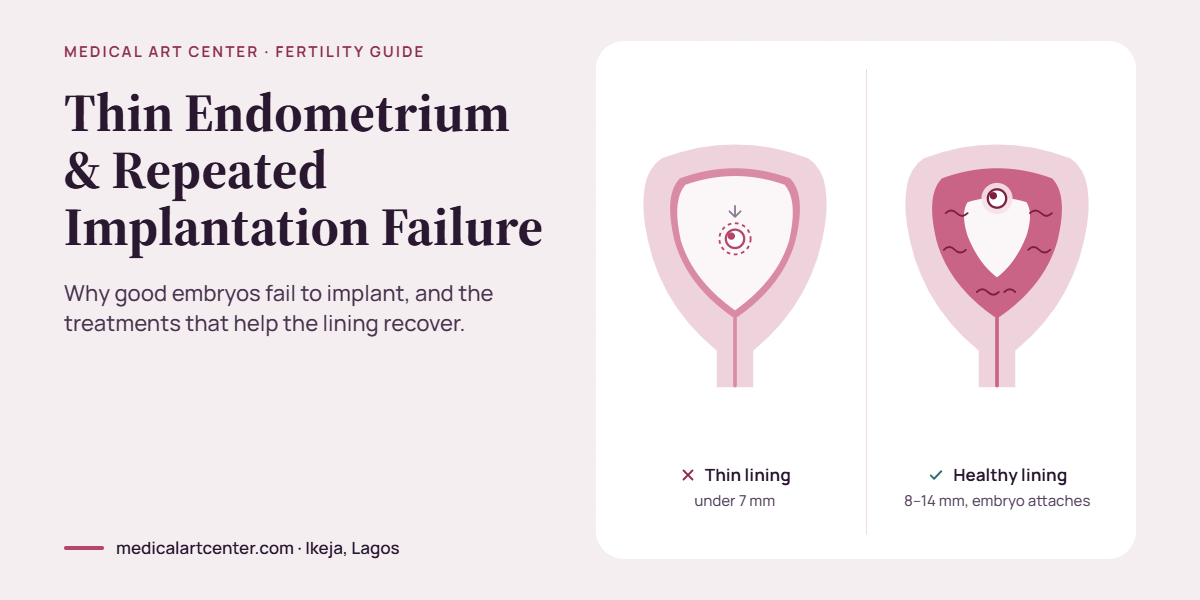
The endometrium is the womb’s inner lining. Each cycle, rising estrogen thickens it and increases blood vessel growth, preparing it to receive an embryo. Before an embryo transfer, your doctor measures it with a transvaginal ultrasound.
| Lining measurement | What it means |
| 8–14 mm, trilaminar (“triple-line”) pattern | Ideal for embryo transfer |
| 7–8 mm | Borderline; may need extra support |
| Under 7 mm | Thin endometrium; implantation rates fall noticeably |
Thickness is not the whole story. The lining also needs a healthy blood supply and the right appearance on scan. A 7 mm lining with good blood flow can do better than a thicker one with poor flow.
What Is Repeated Implantation Failure (RIF)?
RIF means good-quality embryos have been transferred several times without a pregnancy. Definitions vary, but specialists commonly use it after three or more failed transfers of good-quality embryos, or after a set number of good embryos (often 4 or more) have failed to implant. RIF has several possible causes; a thin endometrium is among the most common and easiest to fix.
Why a Thin Lining Causes Failed Embryo Transfers
Implantation depends on a precise conversation between the embryo and the womb. A thin endometrium interrupts that conversation in three ways:
- Poor blood supply. Less blood flow means the embryo receives less oxygen and fewer nutrients during implantation.
- Too much oxygen too close. In a thin lining, the embryo sits nearer the larger blood vessels at the base of the womb. Researchers believe this higher oxygen level may cause oxidative stress that harms the early embryo.
- Weak “cellular Velcro.” A healthy lining makes adhesion proteins (such as integrins) and signaling molecules (cytokines) that help the embryo attach. A thin lining makes fewer of them.
The result: even a chromosomally normal embryo may be unable to attach and grow. This is why your lining deserves as much attention as your embryos.
Causes of a Thin Uterine Lining
Finding the cause is the key to choosing the right treatment. The most common causes are:
- Low estrogen or poor estrogen response. Too little estrogen, or receptors that respond weakly, limits growth.
- Uterine scarring (Asherman’s syndrome). Adhesions can form after a D&C, surgery, a difficult delivery, or a womb infection. Scar tissue cannot grow a normal lining.
- Chronic endometritis. A long-standing, often silent inflammation of the lining that reduces its quality and receptivity.
- Reduced blood flow to the womb. Previous pelvic surgery, fibroids, anatomical factors, or a sedentary lifestyle can restrict circulation.
- Prolonged clomiphene (Clomid) use. This ovulation drug blocks estrogen receptors and can thin the lining over several cycles.
- Age and declining ovarian function. As hormone levels fall toward menopause, the lining naturally thins.
- Lifestyle factors. Smoking, heavy alcohol use, significant over- or underweight, and chronic stress can all affect blood flow and hormones.
Signs You May Have a Thin Endometrium
A thin lining often causes no pain, so many women only find out during fertility treatment. Clues include:
- Very light, short, or irregular periods
- Periods that became lighter after a D&C, miscarriage surgery, or womb infection
- Two or more failed IVF or frozen embryo transfer cycles with good-quality embryos
- Early miscarriage
- Infertility labeled “unexplained” despite normal basic tests
If any of these apply to you, ask your fertility specialist to look closely at your endometrium before your next transfer.
How We Diagnose a Thin Endometrium at Medical Art Center
A thorough work-up turns “unexplained” failure into a clear plan. Depending on your history, we may use:
| Test | What it shows |
| Transvaginal ultrasound (with Doppler) | Lining thickness, pattern and blood flow to the womb |
| Diagnostic hysteroscopy | A direct camera view of the womb cavity to find and treat scar tissue, polyps or fibroids |
| Hormone tests | Estrogen, progesterone and thyroid levels that affect lining growth |
| Endometrial biopsy | Signs of chronic endometritis (silent inflammation) |
| Endometrial receptivity testing | Whether your “implantation window” is displaced, to time the transfer precisely |
Because RIF often has more than one cause, we may also review embryo quality, genetic testing of embryos (PGT-A), and immune factors at the same time.
How to Thicken the Uterine Lining: Treatment Options
No single treatment cures a thin endometrium. We match the treatment to the cause, often combining several steps in one carefully planned frozen embryo transfer (FET) cycle.
1. Removing scar tissue
If hysteroscopy shows adhesions (Asherman’s syndrome) or polyps, we remove them in the same minor procedure. This gives the healthy lining room to regrow.
2. Treating infection and inflammation
We usually treat chronic endometritis with a targeted course of antibiotics, then repeat the check before transfer.
3. Enhanced estrogen protocols
When tablets alone are not enough, we may switch to or add vaginal estrogen, skin patches, or injections. Vaginal estrogen delivers more hormone directly to the womb. We may also extend the estrogen phase to give the lining more time to grow.
4. Improving blood flow to the womb
Options include low-dose aspirin, vaginal sildenafil, and a combination of pentoxifylline with vitamin E, which may improve tissue oxygenation and reduce scarring. Your doctor will advise which, if any, suits you.
5. Regenerative therapies for resistant cases
- PRP (platelet-rich plasma): growth factors concentrated from your own blood are placed into the womb to stimulate the lining. Early studies are encouraging, especially for women whose lining hasn’t responded to other treatments.
- G-CSF: a growth factor given as a uterine infusion that may help some women with a persistently thin lining.
- Stem cell therapy: a newer, still-experimental option for severe scarring, best considered in a research setting.
6. Other options we may discuss
- Endometrial scratch: once widely used; recent large studies show limited benefit, so we recommend it selectively.
- Personalized transfer timing based on receptivity testing.
- Surrogacy (gestational carrier): for the small number of women whose lining cannot be restored despite all treatment.
We will always explain the evidence behind each option, so you can make an informed choice.
When It Isn’t Only the Lining: Other Causes of RIF
A thin endometrium is one piece of the puzzle. If your lining is healthy, or failure continues after treatment, we look at:
- Embryo factors: chromosomal abnormalities invisible under the microscope; PGT-A can screen for them.
- Structural problems: fibroids, polyps, adenomyosis, or fluid in the fallopian tubes (hydrosalpinx).
- Hormonal factors: thyroid disease or inadequate progesterone support after transfer.
- Immune and clotting factors: assessed with a reproductive immunologist where indicated.
- Genetic factors in either partner: checked with a simple blood test (karyotype).
Whole-Body Support and Emotional Care
Healthy habits support every treatment: a balanced diet, regular movement, good sleep, a healthy weight, and no smoking or excess alcohol.
For couples who want a structured wellness program, our MartLife Detox Clinic at Medical Art Center offers Modern Mayr therapy focused on nutrition, gut health, and stress reduction. It is designed to complement, not replace, your medical fertility treatment.
RIF is emotionally exhausting. Counseling or a support group can ease the stress, anxiety, and isolation many couples feel. You do not have to carry this alone.
Frequently Asked Questions
What endometrial thickness is best for embryo transfer? Most clinics aim for 8–14 mm with a triple-line pattern. Pregnancy rates fall when the lining is under 7 mm.
Can a thin endometrium still support a pregnancy? Yes, sometimes. Pregnancies can occur with thinner linings, but the chances improve once you treat the cause.
How long does it take to thicken the uterine lining? It varies. Hormonal adjustments may work within one cycle; recovery after scar-tissue removal can take two to three cycles.
Does PRP work for a thin lining? Early studies are promising, particularly for linings that have not responded to estrogen. Larger trials are still underway.
Can I improve my lining naturally? Regular exercise, not smoking, a balanced diet, and a healthy weight support blood flow. Medical treatment is usually needed when scarring or a hormonal cause is involved.
You Are Not Out of Options
A diagnosis of a thin endometrium can feel like another setback. In reality, it often explains repeated IVF failure and is a problem we can treat.
If you have had failed embryo transfers, let our fertility specialists review your history and build a personalized plan for your next cycle.
Book your consultation at Medical Art Center today
- Call: +234 810 325 1336
- Visit: www.medicalartcenter.com
- Location: Ikeja, Lagos, Nigeria, serving patients across West Africa and beyond
Medical note: This article is for general information and does not replace personal advice from your fertility specialist.