
Causes of Infertility in Men and Women: A Complete Guide for Nigerian Couples
· @Professor Oladapo Ashiru, OFR
Infertility in Nigeria: Breaking the Silence
Trying for a baby without success can feel lonely, especially when friends tell you to “just relax,” or family members ask questions you cannot answer. In Nigeria, many couples suffer in silence because of stigma, misinformation, or fear.
Here is the truth: infertility is a medical condition, not a curse or a reflection of your worth. In most cases, it has a treatable cause.
At Medical Art Center, we believe knowledge is power. Understanding the causes of infertility is the first step towards the right diagnosis, the right treatment, and, for many couples, a healthy baby. This guide explains:
- What infertility is and how common it is
- The main causes of female and male infertility
- Causes that can affect both partners
- How infertility is diagnosed and treated
- When to see a fertility specialist
What Is Infertility?
Infertility is the inability to get pregnant after 12 months of regular, unprotected sex. For women aged 35 and above, doctors use a shorter window of 6 months, because fertility declines faster with age.
There are two types:
- Primary infertility: a couple has never achieved a pregnancy.
- Secondary infertility: a couple has been pregnant before but cannot conceive again.
Infertility can come from the woman, the man, both partners, or from no cause that tests can find.
How common is infertility?
The World Health Organization (WHO) estimates that about 1 in 6 adults worldwide (17.5%) experience infertility at some point in their lives. Rates are similar across high-, middle-, and low-income countries. In other words, infertility does not discriminate between rich and poor.
This makes infertility a major global health challenge. It also shows why couples need access to fertility care that is high-quality and affordable. Many causes of infertility can be prevented, which is why awareness matters, especially among young people.
Causes of Female Infertility
A woman’s fertility depends on three things working well: her ovaries releasing a healthy egg, open fallopian tubes, and a healthy womb for the embryo to implant. Problems with any of these can cause infertility.
1. Ovulation disorders
If you do not ovulate regularly, you cannot get pregnant. Ovulation disorders are among the most common causes of female infertility. They include:
- Polycystic ovary syndrome (PCOS): a hormonal imbalance that makes ovulation irregular or stops it altogether.
- Premature ovarian insufficiency (POI): the ovaries stop working normally before age 40, sometimes called early menopause.
- Hypothalamic dysfunction: the part of the brain that controls reproductive hormones stops sending the right signals, often because of extreme stress, weight loss, or heavy exercise.
- Thyroid disorders and high prolactin: both can disrupt ovulation.
2. Blocked or damaged fallopian tubes
The fallopian tubes are where sperm meets the egg. When the tubes are blocked or scarred, fertilization cannot happen. Common causes include:
- Pelvic inflammatory disease (PID), often from untreated chlamydia or gonorrhoea
- Complications after childbirth, miscarriage or abortion
- Endometriosis
- Previous abdominal or pelvic surgery
3. Uterine and cervical problems
The womb must be healthy for an embryo to implant and grow. Problems include:
- Fibroids: non-cancerous growths that can distort the womb or block the tubes. Fibroids are very common among Nigerian women.
- Polyps: small growths in the womb lining that can prevent implantation.
- Asherman’s syndrome: scarring inside the womb, often after a D&C or infection.
- Congenital anomalies: a womb with an unusual shape from birth.
- Cervical stenosis: a narrowed cervix that makes it hard for sperm to pass.
4. Endometriosis
Endometriosis happens when tissue similar to the womb lining grows outside the womb. It causes inflammation, scarring, and adhesions. These can block the tubes, affect egg quality, and make implantation harder. Painful periods and pain during sex are common warning signs.
5. Age-related fertility decline
A woman is born with all the eggs she will ever have, and both the number and quality of eggs fall with age:
| Age | Approximate number of eggs |
|---|---|
| At birth | 1 to 2 million |
| Puberty | 300,000 to 400,000 |
| Age 37 | About 25,000 |
| Menopause (average 51) | About 1,000 or fewer |
Fertility starts to fall noticeably after 35 and more sharply after 40. With age, the risk of miscarriage and of chromosomal conditions such as Down syndrome also rises.
6. Autoimmune disorders
In autoimmune diseases such as systemic lupus erythematosus (SLE) and antiphospholipid syndrome, the body attacks its own tissues. This can cause inflammation, blood-clotting problems, implantation failure, and recurrent miscarriage.
Causes of Male Infertility
In Nigeria, infertility is often wrongly blamed on the woman alone. In reality, male factors contribute to about half of all cases. That is why both partners should always be tested.
1. Abnormal semen parameters
A semen analysis checks three things. Problems with any of them reduce the chance of pregnancy:
- Low sperm count (oligospermia) or no sperm at all (azoospermia)
- Poor sperm movement (asthenozoospermia)
- Abnormal sperm shape (teratozoospermia)
2. Varicocele and other testicular problems
Healthy testicles are essential for good sperm production. Common problems include:
- Varicocele: enlarged veins in the scrotum that overheat the testicles and lower sperm quality. It is one of the most common treatable causes of male infertility.
- Undescended testicles in childhood
- Injury or trauma to the testicles
- Mumps orchitis: mumps after puberty can damage the testicles
3. Hormonal imbalances
Sperm production depends on hormones from the brain and testicles. Low testosterone (hypogonadism), problems with the pituitary gland, and high prolactin can all reduce or stop sperm production.
4. Ejaculation and sexual problems
In retrograde ejaculation, semen flows backward into the bladder instead of out of the penis. Erectile dysfunction, low libido, and blockages in the tubes that carry sperm can also prevent sperm from reaching the egg.
5. Genetic factors
Chromosomal conditions such as Klinefelter syndrome and small missing sections of the Y chromosome (Y-chromosome microdeletions) can affect sperm production and quality.
Causes of Infertility That Affect Both Partners
Sexually transmitted infections (STIs)
STIs are a major and preventable cause of infertility. WHO estimates that more than 1 million curable STIs are acquired every day worldwide. Most cause no symptoms, so they do damage silently.
- In women, chlamydia and gonorrhoea can lead to pelvic inflammatory disease, which scars and blocks the fallopian tubes.
- In men, infections can damage the testicles and sperm ducts and lower sperm quality and quantity.
- Syphilis and trichomoniasis can also harm reproductive health and pregnancy.
Early testing and complete treatment for both partners protect your future fertility.
Weight and body mass index (BMI)
Being either underweight or overweight disrupts hormone balance. In women, this can stop regular ovulation; in men, it can lower testosterone and sperm production.
Lifestyle factors
Your daily habits affect your fertility. The main ones are:
- Smoking
- Excessive alcohol
- Recreational drugs, including cannabis and anabolic steroids
- Poor nutrition
- For men, frequent heat exposure to the testicles (laptops on the lap, hot baths, tight underwear)
The good news: these are within your control, and positive changes can improve both natural fertility and IVF success.
Environmental and occupational exposures
Regular exposure to certain chemicals can harm eggs and sperm. These include heavy metals (such as lead), petrochemicals, pesticides, and some chemicals in detergents and cosmetics. Jobs involving radiation or extreme heat carry similar risks. If your work involves these, use protective equipment and tell your doctor.
Chronic illnesses
Diabetes, thyroid disease, kidney disease, sickle cell disease, autoimmune diseases and cancer can all affect hormones, reproductive organs or the production of eggs and sperm.
Medications and medical treatments
Chemotherapy, radiotherapy, long-term steroid use and some antipsychotic drugs can reduce fertility. Surgery on the reproductive organs can also cause damage. If you need cancer treatment, ask about fertility preservation (egg or sperm freezing) before you start.
Stress and emotional wellbeing
Stress alone rarely causes infertility, but severe or long-term stress can disturb the hormones that control ovulation and sperm production. Infertility itself is also stressful, which is why emotional support is part of good fertility care.
Unexplained infertility
In about 15 to 30% of couples, no clear cause is found even after thorough testing. This is called unexplained infertility. It does not mean there is no hope: many of these couples conceive with treatments such as IUI or IVF.
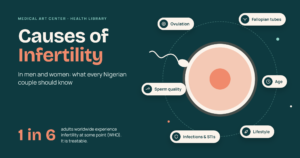
Understanding the Causes of Infertility
How Infertility Is Diagnosed at Medical Art Center
Finding the cause is the key to the right treatment. At our Lagos fertility clinic, we evaluate both partners from the first visit because early, complete testing saves time, money, and emotional stress.
| Who | Tests | What they show |
|---|---|---|
| Woman | Hormone tests (FSH, LH, AMH, prolactin, thyroid) | Egg reserve and hormone balance |
| Woman | Ovulation tracking | Whether and when you ovulate |
| Woman | Transvaginal ultrasound | Fibroids, polyps, ovarian cysts, PCOS, adenomyosis |
| Woman | HSG (hysterosalpingogram) | Whether the fallopian tubes are open |
| Woman | Hysteroscopy or laparoscopy (if needed) | Problems inside the womb, endometriosis, adhesions |
| Man | Semen analysis | Sperm count, movement and shape |
| Man | Hormone tests (testosterone, FSH, LH, prolactin) | Causes of low sperm production |
| Man | Scrotal ultrasound (if needed) | Varicocele and testicular problems |
| Both | STI screening | Hidden infections |
| Both (if needed) | Genetic or immunological tests | Chromosomal, genetic or immune causes |
Not every couple needs every test. Your specialist will tailor the evaluation to your history.
Fertility Treatment Options
Once your specialist knows the cause, they will recommend a personalized plan. Treatment ranges from simple steps to advanced assisted reproductive technology (ART).
Lifestyle and medical treatment
- Weight, nutrition and stress management
- Treating infections, thyroid problems or high prolactin
- Ovulation induction with medicines such as letrozole or clomiphene
Surgery
- Laparoscopy to treat endometriosis, remove adhesions or repair tubes
- Hysteroscopy to remove polyps, some fibroids and womb scarring
- Myomectomy for larger fibroids
- Varicocele repair for men
Assisted reproductive technology (ART)
- IUI (intrauterine insemination): washed sperm is placed directly in the womb around ovulation.
- IVF (in vitro fertilization): we collect eggs, fertilize them in our laboratory, and transfer an embryo into the womb. A cycle usually takes 4 to 6 weeks.
- ICSI (intracytoplasmic sperm injection): a single sperm is injected into each egg. It is ideal for severe male infertility.
- PGT (preimplantation genetic testing): screens embryos for chromosomal problems before transfer.
- Surgical sperm retrieval for men with no sperm in the ejaculate
- Egg donation and surrogacy where needed
- Fertility preservation: freezing eggs or sperm for later use
When Should You See a Fertility Specialist?
Do not wait too long. Book a consultation if:
- You are under 35 and have not conceived after 12 months of trying
- You are 35 or older and have not conceived after 6 months
- You are over 40 (see a specialist straight away)
- You have irregular, very painful, or absent periods
- You have had two or more miscarriages
- You have a history of pelvic infections, STIs, fibroids or endometriosis
- The man has a low sperm count, erectile problems, low libido or past testicular injury
Protecting your fertility: advice for young people
Many causes of infertility can be prevented. To protect your future fertility:
- Practice safe sex and get tested and treated early for STIs
- Avoid smoking, excess alcohol and recreational drugs
- Keep a healthy weight and eat a balanced diet
- Seek medical care early for painful or irregular periods
- Avoid unsafe abortions, which can scar the womb and tubes
- Know that fertility declines with age, and plan accordingly
Why Choose Medical Art Center?
At Medical Art Center in Lagos, we combine advanced reproductive science with compassionate, personal care.
- An expert, collaborative team: specialists in reproductive medicine, embryology, and andrology, plus fertility surgeons, work together on your case.
- Advanced diagnostics: modern ultrasound and laboratory testing for an accurate diagnosis.
- The full range of treatment: from ovulation induction to IVF, ICSI, PGT, and fertility preservation, under one roof.
- Clear communication: we explain your options, success rates, and costs honestly.
- Emotional support: we care for the couple, not just the condition.
Ready to take the first step?
Call +234 902 068 2435 or book a consultation with our fertility specialists today.
Frequently Asked Questions About the Causes of Infertility
What is the most common cause of infertility?
In women, ovulation disorders such as PCOS and blocked fallopian tubes are among the most common causes. In men, abnormal sperm count, movement, or shape is the most common cause. Often, both partners contribute.
Is infertility always the woman’s fault?
No. Male factors are involved in about half of all cases. Test both partners from the start.
Can infertility be cured?
Many causes can be treated, for example with ovulation medicines, surgery for fibroids or blocked tubes, or IVF and ICSI. Even when the cause cannot be reversed, many couples still have a baby with assisted reproduction.
Can lifestyle changes really improve fertility?
Yes. Reaching a healthy weight, stopping smoking, cutting down on alcohol, and managing chronic conditions can improve natural fertility and the success of treatments like IVF.
What is unexplained infertility?
It means standard tests have not found a cause. About 15 to 30% of couples fall into this group, and many conceive with IUI or IVF.
How long does an IVF cycle take?
From ovarian stimulation to embryo transfer, a typical IVF cycle takes about 4 to 6 weeks.
What are the risks of IVF?
IVF is generally safe. The main risks are ovarian hyperstimulation syndrome (OHSS) and multiple pregnancy. Your doctor will discuss your personal risks in detail.
Final Thoughts: Infertility Is Treatable
Infertility has many possible causes: biological, lifestyle, and environmental. It can affect the woman, the man, or both. Understanding these causes helps couples seek care early and helps young people protect their future fertility.
The most important step is a proper evaluation by a fertility specialist. With today’s advances in reproductive medicine, many couples who once struggled now have their own babies.
If you have been trying to conceive without success, you do not have to face it alone. Call +234 8103251336 or book a consultation with Medical Art Center today.
Related reading
- Understanding IVF: What Every Nigerian Couple Should Know
- Male Infertility: Causes and Treatment Options
- How to Support Your Partner During IVF in Nigeria
- How Much Does IVF Cost in Nigeria?
This article is for general information and does not replace personal medical advice. Please consult a qualified fertility specialist about your situation.